How to Respond to Negative Reviews: A Guide for Business Owners
Every business that serves the public eventually gets a bad review. It might be fair, it might be unfair, and it often shows up at the worst possible time. Either way it stings, and the first instinct is usually to defend yourself or to pretend it isn’t there.
Neither one helps. A negative review is a public conversation, and the person you most need to reach often isn’t the reviewer. It’s the next customer reading your profile and deciding whether to call you.
We put this guide together so our clients have something to turn to when a bad review lands. Below we cover why your reply matters, what to do before you write it, how to structure it, what to avoid, how to handle fake reviews, and how to build a steady flow of honest reviews so one bad day doesn’t define your business.
Why Your Reply Matters
Your reviews are often the first thing people see. In BrightLocal’s 2026 Local Consumer Review Survey, 97% of consumers said they read reviews for local businesses, and 89% said they expect business owners to respond.
The same survey shows both the risk and the opportunity. 77% of consumers said they are less likely to use a business after reading negative reviews. But 80% said they are likely to use a business that responds to all of its reviews, while 42% said they are unlikely to use one that never replies.
In other words, you can’t control every review, but you can control what readers see next to it. A calm, helpful reply tells them how you treat people when something goes wrong, and that is exactly what they are trying to find out.
A good reply can also help with the customer who wrote the review. Researchers call this the service recovery paradox: a customer whose problem is handled well can end up more satisfied than if nothing had gone wrong. That same research did not find a reliable lift in repeat business, so a complaint is never good news. It does mean that a bad experience doesn’t have to be the last word.
Before You Reply
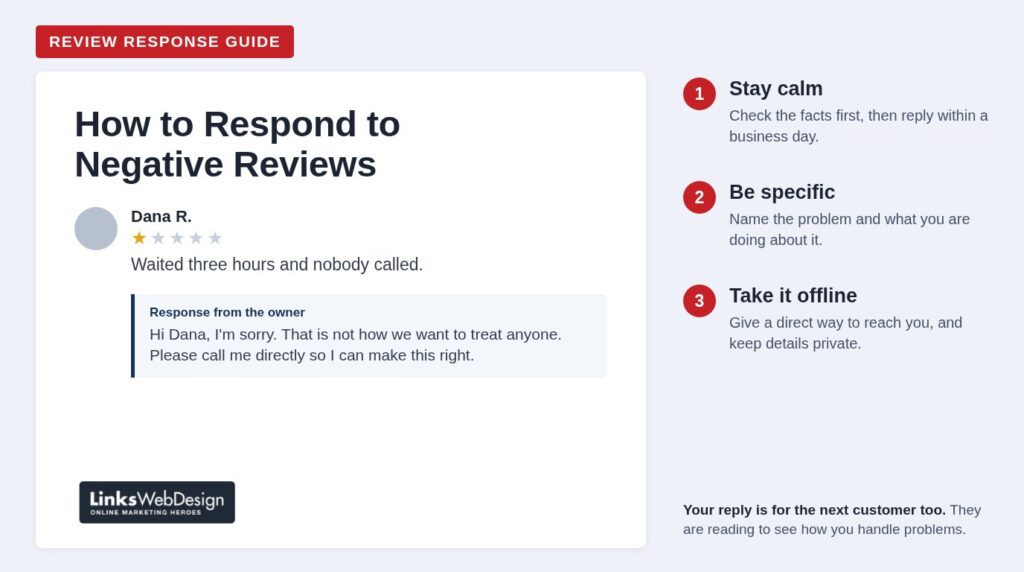
The most damaging replies are written in the first ten minutes. Take these steps first:
- Read the review twice. Look for the actual complaint underneath the frustration. It’s usually one specific thing, such as a late arrival, a surprise on the bill, or a phone call nobody returned.
- Find out what happened. Check your records and talk to the people involved, so that your reply is based on facts and not on your memory or your mood.
- Check that it’s a real customer. Search your records for the name, keeping in mind that people often post under nicknames or a family member’s account. If it doesn’t appear to be a customer, see the section on fake reviews below.
- Decide who should reply. Choose someone calm who can actually fix things. Avoid having the employee named in the review write the reply.
- Respond promptly, but not angrily. Aim to reply within one business day. BrightLocal found that 19% of consumers expect a response the same day and 81% expect one within a week, so a thoughtful reply tomorrow beats an angry one right now.
Why People Leave Negative Reviews
Knowing what the reviewer wants makes the reply much easier to write. Most negative reviews fall into one of these groups.
They Have a Problem That Still Needs Fixing
This person may not be finished with you. A billing question, a repair that didn’t hold, or an unanswered message can often be solved with one phone call. Your job is to make it as easy as possible to reach the right person.
They Want You to Know Something Should Change
Some reviewers aren’t asking for anything. They liked you overall and want to flag one thing that bothered them, such as a hard-to-reach front desk or a confusing process. Thank them and take the feedback seriously, because they are telling you what other customers may be thinking.
There Was a Misunderstanding
Sometimes a customer expected something you never promised. Clear up the facts gently and without blame. You can use the moment to explain how things work, which helps every future customer who reads it.
They Simply Can’t Be Satisfied
A few people won’t be happy no matter what you do. Reply once, politely, and then stop. That reply is really for the people reading it, and they can usually tell when a reviewer is being unreasonable.
What a Good Reply Includes
A strong reply is short and specific. Three to five sentences is plenty. Here is what to put in it:
- A thank-you and a greeting. Use the name shown on the review if your industry allows it. Thank them for taking the time, even if the review is harsh.
- The specific issue, in your own words. Naming what went wrong shows that a real person read the review. “Waiting three hours without a call” says far more than “your experience.”
- A sincere apology. Apologize for how things went without excuses. You can be sorry that someone had a bad experience even when you’re still looking into what happened.
- What you’re doing about it. If you have changed something, say so. Only mention changes you have actually made.
- A direct way to reach you. Give a name and a phone number or email address, and invite them to continue the conversation privately. Details belong in that conversation, not in a public thread.
- A real signature. On Google, approved replies appear under your business name, so signing with a first name and title reminds readers that a person wrote it.
Before you post, read the reply as if you were a stranger deciding whether to hire your company. If it sounds defensive, rewrite it.
A Before and After Example
Here is a review a home service company might receive:
Waited three hours for the technician and nobody called. Never using this company again.
A reply that makes things worse:
We have no record of any delay. Our technicians are very busy, and customers need to understand that schedules change. We have hundreds of five-star reviews from people who were happy with us.
This reply calls the customer wrong, blames them for being upset, and brags. Every reader now knows what happens if they complain.
A reply that helps:
Hi Dana, thank you for letting us know. Waiting three hours without a call is not how we want to treat anyone, and I’m sorry. We’ve changed our dispatch process so customers now get a text whenever a technician is running more than 30 minutes behind. I’d like to make this right, so please call me directly at [phone number]. Mike, Owner
This reply names the problem, apologizes without excuses, shows a real change, and moves the conversation offline. Dana may or may not call, but everyone reading now has a good reason to trust this company.
Starting Points You Can Adapt
It helps to have a few starting points, especially if several people answer your reviews. Treat these as outlines and not as copy-and-paste replies. BrightLocal found that 50% of consumers are unlikely to choose a business whose replies are generic or templated, so every reply needs details from the actual review.
When you clearly fell short:
Hi [name], thank you for telling us about [specific issue]. That isn’t the experience we want anyone to have, and I’m sorry. [What you’ve changed or what you’ll do next.] Please reach me directly at [phone or email] so I can make this right. [First name], [title]
When you need more information:
Hi [name], I’m sorry to hear this, and I’d like to look into it. I don’t have enough detail yet to know what went wrong. Would you call me at [phone number] or email [email address]? [First name], [title]
When the feedback is fair and you’re acting on it:
Thanks for the honest feedback, [name]. You’re right about [specific issue], and we’ve [specific change] because of it. We appreciate you helping us improve, and I hope you’ll give us another chance. [First name], [title]
When a key fact is wrong:
Thanks for your feedback, [name]. I’m sorry this wasn’t what you expected. To clear up one detail for anyone reading, [one neutral fact, with no customer details]. I’d be glad to talk this through at [phone number]. [First name], [title]
What Not to Do
A bad reply can do more harm than the review itself. Avoid these common mistakes:
- Don’t argue or get sarcastic. Even if you’re completely right, a public argument makes you look worse than the review does.
- Don’t share customer details. Never post what someone bought, what they paid, or anything else they didn’t mention themselves.
- Don’t paste the same reply everywhere. Readers notice, and it suggests that nobody is really listening.
- Don’t offer anything in exchange for a change. Google’s policy doesn’t allow you to offer money, discounts, or free goods or services to get a review changed or a negative review removed. Fix the problem because it’s the right thing to do, and let the customer decide what to do with their review.
- Don’t threaten the reviewer. The FTC’s Consumer Reviews and Testimonials Rule, in effect since October 2024, addresses intimidation, unfounded legal threats, and knowingly false accusations used to remove or prevent negative reviews.
- Don’t pay a “review removal” company. You’ll see ads promising to erase bad reviews. No outside company has a special way to delete them. A review comes down when the reviewer removes it or the platform decides it breaks the rules, and you can report it yourself for free.
- Don’t fight back with fake reviews. Buying reviews or writing them yourself can violate the FTC rule, and Google removes fake engagement. Google also treats reviews from employees, contractors, and relatives as conflicts of interest.
- Don’t ignore it. Silence leaves the complaint as the only side of the story.
How to Handle Fake or Policy-Breaking Reviews
A review you disagree with isn’t the same as a review that breaks the rules. A harsh but genuine review will almost certainly stay up. Reviews that may qualify for removal include fake engagement, posts from a competitor, reviews from someone with a conflict of interest, and content that breaks Google’s other policies.
If you believe a Google review crosses that line, here is how to handle it:
- Save a copy. Take a screenshot of the review before you do anything else.
- Report it. From your Business Profile, open your reviews, select the report icon by the review, choose a reason, and send it. You can also use Google’s Reviews Management Tool. Google’s instructions cover both.
- Track the status. The Reviews Management Tool shows where your report stands, including whether Google found a policy violation.
- Appeal if it makes sense. If a review you flagged isn’t removed, the same tool offers a one-time appeal.
- Reply anyway. There is no guarantee that Google will take the review down, and it can take time, so don’t leave it unanswered in the meantime.
Your reply can be polite and still let readers know that something is off, without accusing anyone of lying:
Hi [name], we’d like to look into this, but we aren’t able to tell from your review what it refers to. Please contact [name] at [phone number] with more detail so we can help.
Other platforms, including Facebook and Yelp, have their own reporting tools and rules, so check the rules for each site where you have a listing.
Healthcare and Other Confidential Businesses
If you are a doctor, dentist, chiropractor, therapist, or other provider covered by HIPAA, a patient’s public review doesn’t give you permission to discuss their care in public. Even confirming that someone is your patient can be a problem, so replies like “we have no record of you as a patient” or “as we discussed at your visit” are best avoided.
This isn’t a theoretical risk. In 2019, Elite Dental Associates in Dallas paid $10,000 to settle a federal complaint over patient information posted in its replies to Yelp reviews. In 2022, New Vision Dental in California paid $23,000 after its owner shared patients’ names, treatment, and insurance details in review responses.
The safe approach is a general reply that doesn’t address the person’s situation at all:
We take all feedback seriously and want everyone who comes to us to have a good experience. Privacy rules prevent us from discussing anyone’s care here, but we welcome a call at [phone number].
Attorneys, financial professionals, and others with confidentiality obligations should be just as careful. This guide isn’t legal advice, so check with your compliance contact or attorney about what’s right for your business.
Build a Steady Flow of Honest Reviews
The best protection against a negative review is having plenty of recent, genuine ones around it. One bad review among 200 looks like a rare miss. One bad review among five looks like a pattern. Google also says that more reviews and positive ratings can help your local ranking.
Happy customers often don’t think to leave a review, so you have to ask. Some simple ways to make it easy:
- Ask everyone. Make the request part of your routine, whether that’s after every job, sale, or appointment.
- Ask soon. A request sent the same day, while the experience is fresh, is more likely to get a response.
- Send a direct link. Put a link to your Google review form in your follow-up email, text message, invoice, or email signature so customers don’t have to search for it.
- Turn on notifications. Make sure someone at your business gets an alert when a new review comes in. If you have many locations or get a high volume of reviews, review management software can help track them in one place.
There are also some rules to follow when you ask:
- Don’t ask only happy customers. Google’s policy doesn’t allow businesses to discourage negative reviews or selectively ask for positive ones. That includes “review gating,” where a survey sends satisfied customers to Google and steers unhappy customers somewhere else. The FTC’s rule doesn’t specifically ban this, but the FTC says the practice could still violate the FTC Act.
- Don’t offer incentives. Google doesn’t allow payment, discounts, or freebies for reviews, even if you aren’t asking for a positive one.
- Don’t set staff quotas. Your team can ask customers for reviews, but Google doesn’t allow pressuring employees to hit a number of reviews or to get reviews that mention them by name.
Let Your Reviews Improve Your Business
Once the reply is posted, there’s still value in the review. Every few months, read through your recent reviews and look for patterns. If several people mention the same problem, such as slow callbacks or unclear pricing, you’ve found something worth fixing. Share what you find with your team, and don’t forget the positive reviews. Recognizing an employee who earned a compliment goes a long way.
Remember to reply to your good reviews too. It only takes a moment, and customers notice when a business responds to everyone and not just its critics.
Frequently Asked Questions
Should I respond to every negative review?
Almost always. The exceptions are reviews that contain threats, hate speech, or other abusive content. Report those and consider getting advice before you engage. In any case where you’re tempted to write something angry, wait and have someone else read your reply first.
Can I delete a bad review from my Google Business Profile?
No. Business owners can’t remove Google reviews. You can flag a review that you believe breaks Google’s policies, and the reviewer can edit or delete it.
Can I ask a customer to update their review after I fix the problem?
You can let them know they’re welcome to update it if they feel the situation has been resolved, as long as there’s no pressure and you don’t offer anything in exchange. Reviewers can edit their reviews after you reply, and many people do so without being asked.
Can I use AI to write my replies?
AI can give you a helpful first draft, especially when you’re upset and struggling to find the right tone. Always rewrite it with the real details of the situation, check that every statement is true, and never paste in private customer information. A reply that reads like a form letter will hurt more than it helps.
Do replies help my search rankings?
Google says positive reviews and helpful replies can help your business stand out, and that more reviews and positive ratings can help your local ranking. Treat replies as a customer service habit first. The benefit you can count on is what your replies show to the people reading them.
How We Can Help
At Links Web Design, we help businesses across Maine, Florida and beyond build their websites and strengthen how they appear on Google. If you’d like help cleaning up your Google Business Profile, creating a direct review link, or making it easier for customers to leave feedback, contact us.