What the php2shell PHP Vulnerabilities Mean for Your Website
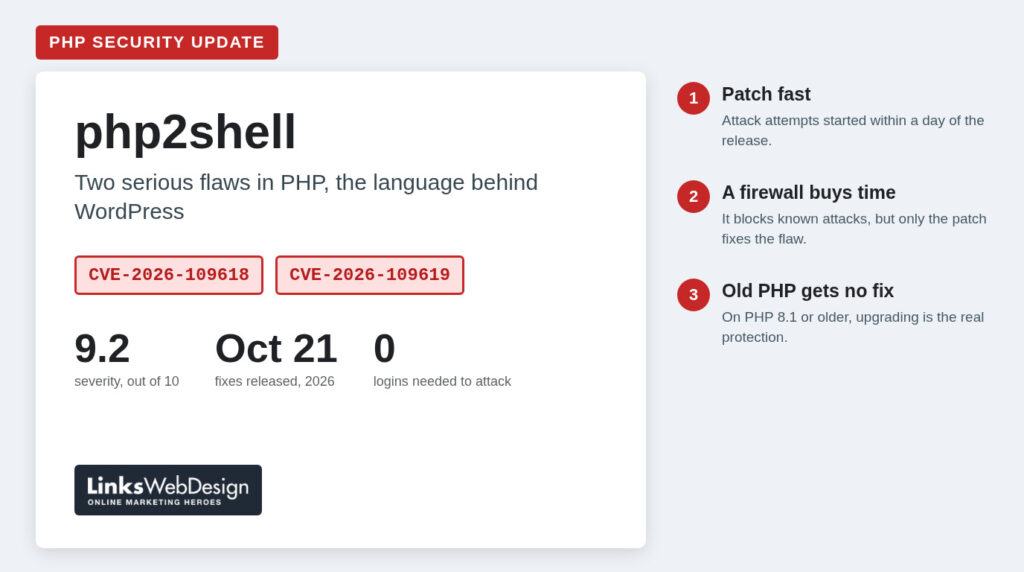
On October 21, 2026, the PHP project announced two serious security flaws and released fixed versions the same day. Security researchers and vendors have been calling the pair “php2shell.” If you saw a headline and wondered whether your website is affected, this post is for you.
The short version first. If we host your website, our servers already have the fix and you do not need to do anything. If your site is hosted elsewhere, or runs on an old version of PHP, keep reading.
What PHP Is and Why This Matters
PHP is the programming language that runs WordPress and a large share of all websites. You never see it, but it builds every page your visitors load.
These two flaws live in PHP itself, before WordPress or any plugin runs. So a WordPress site with every plugin up to date is still affected if the PHP underneath it has not been updated.
What Was Found
The two flaws are tracked as CVE-2026-109618 and CVE-2026-109619. They are rated 9.2 out of 10 on the standard severity scale (CVSS v4). An attacker does not need an account or a password to try them.
In plain terms, the first flaw is in how PHP handles certain file-upload style form submissions. A crafted request can make PHP run out of memory in a way an attacker can abuse. The second flaw lets leftover data from one failed request get reused by the next request the same process handles.
Pulling off an attack is not simple. The flaws are rated high complexity. But in some server setups the first one allows remote code execution. That means an attacker could run their own code on the server and take over the site.
Why Speed Matters
The fixes were released on October 21. Proof-of-concept exploit code began circulating publicly. Cloudflare reported seeing attack traffic that same day, and security firms reported active attempts to exploit the flaws. As of October 21 there were no confirmed reports of sites actually being compromised, but the attempts were already under way.
That timeline is normal now. Once a flaw is public, automated tools scan the internet for sites that have not been patched. A host that applies updates a few weeks later leaves every site it runs exposed for all of that time.
A Firewall Helps, but It Is Not the Fix
Cloudflare deployed emergency firewall rules for these flaws on October 21. Those rules block known attack patterns before they reach the server. That is real protection, and it buys time.
Two things limit it. First, the rules only protect traffic that passes through Cloudflare. Second, a firewall blocks the attack attempts it recognizes. It does not remove the flaw. Only the fixed version of PHP does that.
The same goes for configuration changes. Some settings reduce the risk, but the PHP security advisories say there is no complete configuration-only fix. The patch is the fix. Everything else is a layer on top of it.
If Your Site Runs on Old PHP, This Is the Hard Part
The PHP project released fixed versions for PHP 8.2, 8.3, 8.4 and 8.5 (specifically 8.2.35, 8.3.36, 8.4.27 and 8.5.12). Those are the versions the project still supports.
PHP 8.1 and everything before it are past their end of life. The PHP project no longer publishes official releases for them, including security fixes. A fix for one of those versions exists only where a third-party vendor chose to build one. Many hosting providers have said they will not ship fixes for PHP 8.1 or older. Some very old versions, like PHP 5.x, have no fix available from most hosts at all.
Older versions are affected just like newer ones. So a site still on PHP 7 or PHP 5 has the flaw and, from most hosts, no patch coming.
If that describes your website, upgrading PHP is the only real protection. A firewall and careful settings reduce the risk while you plan the move. They cannot close it. And this will not be the last PHP flaw. Each new one leaves an unsupported site further behind.
How We Responded
We were tracking the release before it came out and had already inventoried the exact PHP version on every server we manage, so we knew what needed updating and where.
We installed the fixed PHP versions on our servers within hours of the release. Then we checked every server rather than assuming the update took.
Most of the sites we host sit behind Cloudflare, which added firewall rules blocking attack attempts. That gave an extra layer between disclosure and the patch, and it stays in place now.
A small number of older sites we host still run unsupported PHP versions, where no patch exists. For those, we applied extra protective settings to reduce the risk, and we are contacting those owners directly about upgrading.
What Managed Hosting Buys You
Nobody expects a business owner to follow PHP security announcements. That is the job of whoever hosts your site. A few questions are worth asking them.
- Do they know what PHP version each site runs?
- How quickly do they apply security releases? Hours, days, or weeks?
- Is there a firewall in front of the site, and does it get emergency rules when a flaw like this appears?
- Will they tell you when your PHP version is reaching end of life, and help you move?
If the honest answer is “we are not sure,” the site is depending on luck. Managed hosting exists so it does not have to.
Frequently Asked Questions
If Links Web Design hosts my site, do I need to do anything?
No. Our servers were updated with the fixed PHP versions within hours of the release and verified afterwards. If your site is one of the few still on an unsupported PHP version, we have added extra protective settings and will contact you directly about upgrading.
My WordPress site has all its plugins and themes up to date. Is it still affected?
Yes, if the PHP underneath it has not been updated. These flaws are in PHP itself, before WordPress or any plugin runs. Keeping plugins current still matters, but only your host can install the patched PHP version.
How do I find out what PHP version my site runs on?
Ask your host or your web team. In WordPress, an administrator can also see it under Tools, then Site Health, on the Info tab. If the version starts with 8.1, 7, or 5, it is no longer supported and has no official fix for these flaws.
Can I rely on a firewall instead of upgrading my old PHP?
A firewall reduces the risk, and we recommend one. It does not remove the flaw, and it only sees traffic that passes through it. Only the patched version fully fixes the problem. For an unsupported version, that means upgrading.
How We Can Help
At Links Web Design, we host and maintain websites for businesses across Maine, Florida and beyond, and watching for issues like this one is part of the job. If you are not sure what PHP version your site runs, whether your host has applied these fixes, or what it would take to move an older site to a supported version, we are glad to take a look. Contact us at our contact page. You can also reach Ken Kimball directly at [email protected].